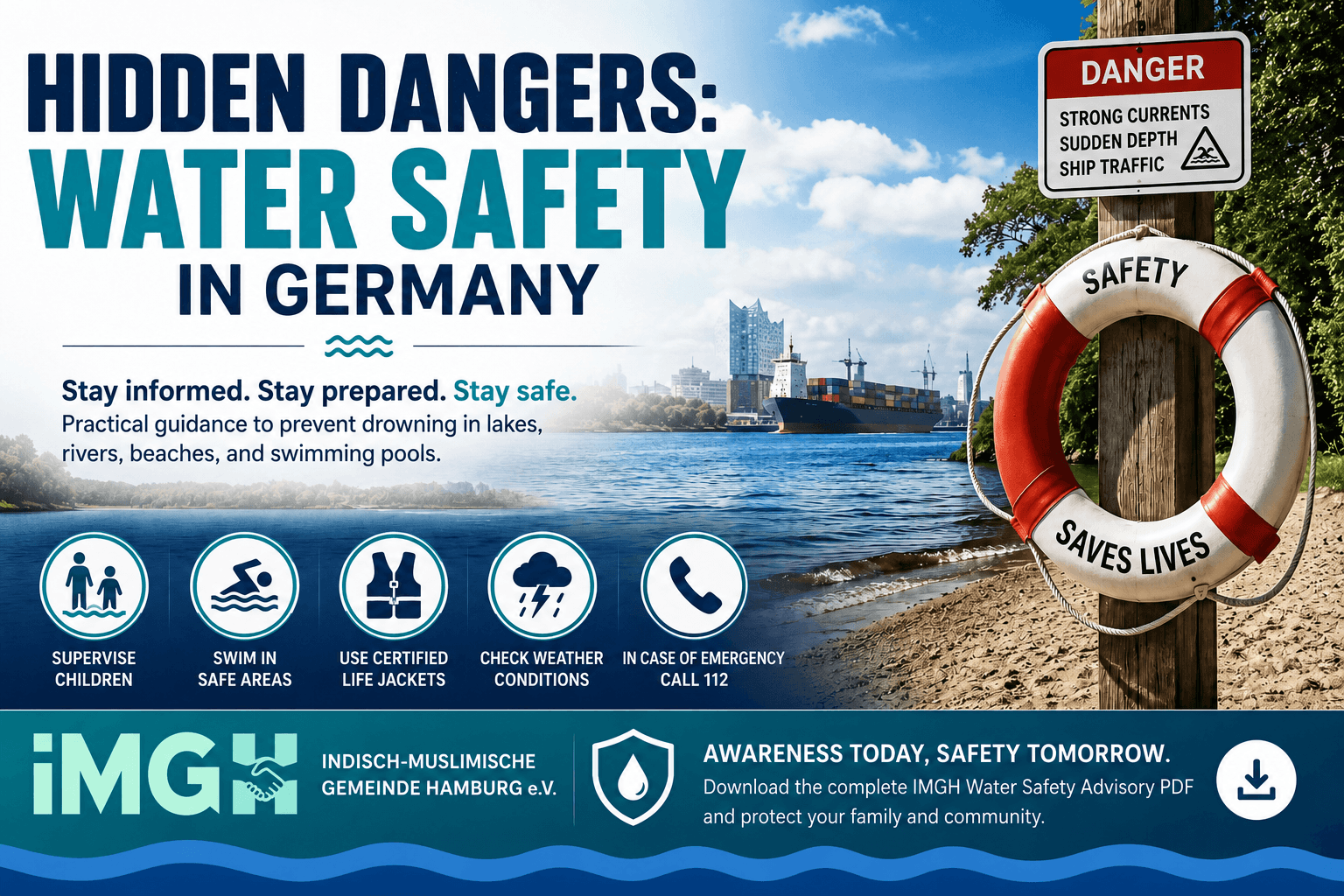
Every summer, thousands of families across Germany head to lakes, rivers, beaches, and swimming pools to enjoy the warm weather. While these places offer relaxation and fun, they also hide risks that many people—especially newcomers to Germany—do not fully understand.
Unlike many countries where swimming mostly happens in pools, Germany has thousands of natural lakes, rivers, canals, and reservoirs. These beautiful locations often look calm on the surface but can contain powerful undercurrents, sudden temperature changes, steep drop-offs, and dangerous boat traffic.
To help raise awareness, Indisch-Muslimische Gemeinde Hamburg e.V. (IMGH) has prepared a comprehensive Water Safety Advisory that explains the hidden dangers of German waters and provides practical advice that can save lives.
Why This Guide Matters
Every year, preventable drowning incidents occur across Germany. Many of these accidents involve people who underestimate natural water conditions or are unfamiliar with local hazards.
The advisory highlights that drowning incidents occur throughout Germany, with some federal states recording significantly higher numbers due to their geography and popularity for water recreation. It also explains that lakes, rivers, canals, and even beaches each present different types of risks.
German Waters Are Different Than They Look
One of the biggest misconceptions is that calm water is always safe.
Natural water bodies in Germany can contain:
- Extremely cold water beneath warm surface layers
- Strong underwater currents
- Sudden depth changes
- Thick underwater vegetation
- Hidden rocks and debris
- Waves created by large commercial ships
These hazards are often invisible until it is too late. The guide explains how rivers, lakes, and coastal areas each have unique dangers that require different safety precautions.
Lakes Cause the Highest Number of Incidents
According to the advisory, lakes account for the largest share of drowning incidents, followed by rivers.
This surprises many people because lakes appear peaceful compared to fast-moving rivers. However, lakes often contain:
- Cold undercurrents
- Sudden deep sections
- Limited visibility
- Unexpected temperature changes that can cause physical shock
Rivers add additional dangers through powerful currents, floating debris, and changing water levels.
Summer Is the Highest Risk Season
The guide shows a clear seasonal trend.
As temperatures rise, more people visit beaches and lakes, causing incidents to increase dramatically during early and mid-summer. July records the highest number of reported incidents, making it one of the most important months for water safety awareness.
A Special Warning About Hamburg’s Elbe Beach
For residents of Hamburg, the advisory includes an important warning about the Elbe.
Many people see the sandy beaches and assume it is safe for swimming. In reality, the Elbe is one of Europe’s busiest shipping routes.
Large container ships create dangerous water movements:
- Water is first pulled away from the shoreline.
- Curious swimmers may walk further into the river.
- Seconds later, a powerful surge wave returns.
- Children and inexperienced swimmers can be swept away almost instantly.
This is one of the least understood water hazards in Hamburg and deserves serious attention.
Essential Safety Rules Everyone Should Follow
The advisory recommends several simple habits that significantly reduce risk:
Always
- Swim only where lifeguards are present.
- Never swim alone.
- Enter cold water gradually.
- Stay with friends or family.
- Watch weather conditions carefully.
Never
- Swim after drinking alcohol.
- Depend on inflatable toys for safety.
- Enter open water during storms.
- Ignore warning signs or barriers.
These straightforward rules can prevent many water-related emergencies.
Children Need Constant Supervision
One of the strongest messages in the guide is directed toward parents.
Children can drown silently within seconds.
The advisory recommends:
- Maintaining constant visual contact.
- Staying within arm’s reach of toddlers.
- Using only certified life jackets.
- Enrolling children in swimming lessons such as Germany’s Seepferdchen program.
Looking away for even a short moment to check a phone can have tragic consequences.
What To Do During an Emergency
If someone is in trouble in the water:
- Call 112 immediately.
- Do not attempt dangerous rescues unless it is safe to do so.
- Begin CPR if the victim is unconscious and not breathing.
- Clearly explain:
- Who is calling
- Where you are
- What happened
- How many people are injured
Quick action during the first few minutes can save a life.
A Simple Family Water Safety Plan
The guide also encourages families to prepare before visiting any water location.
A practical safety plan includes:
- Identifying local water hazards.
- Learning basic first aid and CPR.
- Buying certified life jackets.
- Teaching children swimming skills.
- Agreeing on supervision responsibilities before entering the water.
Prepared families are far less likely to experience emergencies.
Download the Complete Water Safety Guide
This article only covers the key highlights.
The complete IMGH Water Safety Advisory includes:
- German drowning statistics
- Regional risk analysis
- Seasonal trends
- Hamburg-specific safety guidance
- Child protection recommendations
- Emergency response procedures
- Family preparedness checklist
📄 Download the full PDF below to read the complete advisory and share it with your family and friends.
Final Thoughts
A day at the lake or beach should end with happy memories—not tragedy. Most drowning incidents can be prevented through awareness, preparation, and responsible supervision.
Whether you have lived in Germany for years or have recently arrived, taking a few minutes to understand the unique risks of German waters could one day save your own life—or someone else’s.
Stay informed. Stay prepared. Stay safe.